
Victoria Waddington
Born in Newcastle in 1948, Vicky went on to study textiles and design in Manchester before a career in fashion with Ben Sherman Shirts and as an administrator with Asylum Models.
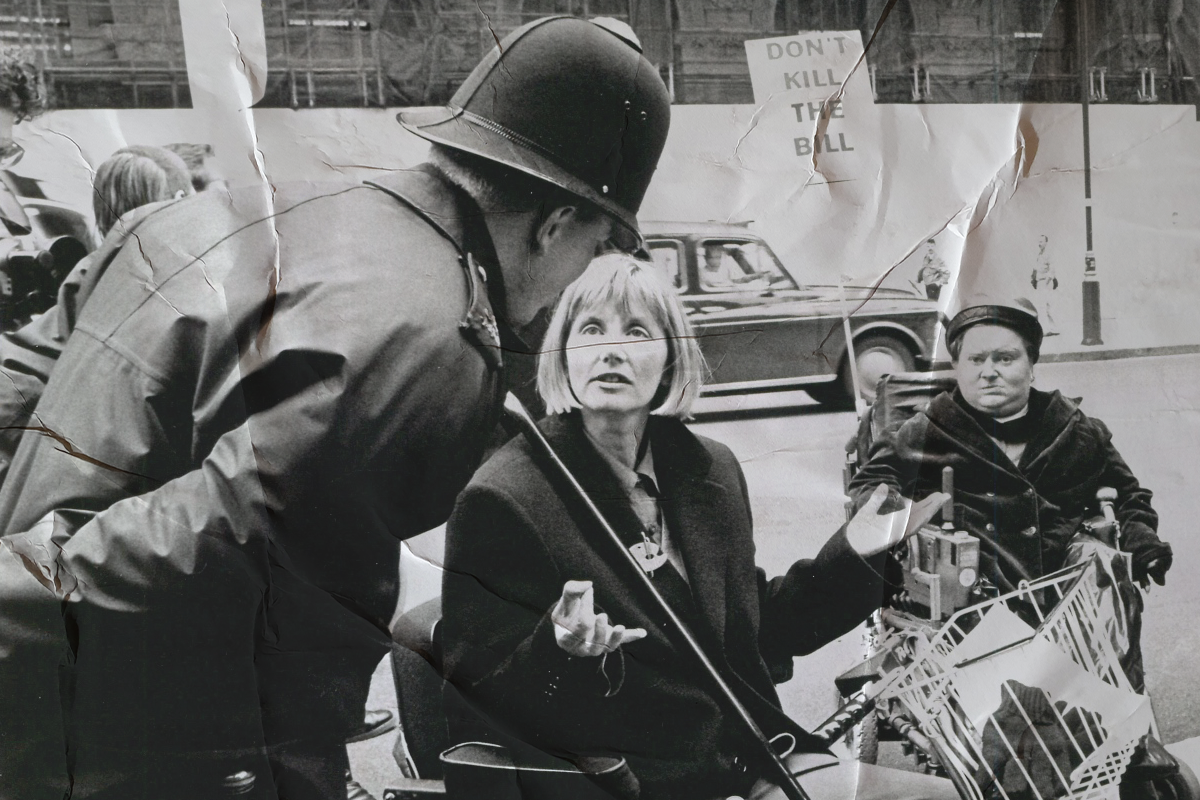
She protested with the Campaign for Accessible Transport (CAT), taking part in marches and demonstrations, which eventually helped to bring changes in law that made public transport accessible to Disabled people.
In May 1990 Vicky and her partner Allan Sutherland organised the press and promotion for the Campaign to Stop Patronage, a united action by artists and activists which, followed by the Block Telethon protest in 1992, led to ITV discontinuing this programme.
Later in 1990, CAT organised a demonstration in London’s Oxford Street, stopping buses which led to gridlocked traffic throughout the West End. Vicky described it as one of the greatest days of her life when she was arrested along with 16 other Disabled protesters making the front page story in the Evening Standard.
Awarded the 1990 Brisenden Bursary award for outstanding service to Disabled people, Vicky was given access to a wide range of training programmes; project planning, marketing, negotiating and team building, skills which she used to develop the access consultancies she ran, firstly All Clear Designs and Victoria Waddington Associates.
Vicky became one of the leading disabled access consultants in the country, securing a contract with BBC Television in 1990. She interviewed all 35 disabled staff within the corporation and audited the Television’s Centre’s nine buildings, studios and galleries.
At the beginning of the 1990s with the support of Wendy Harpe, Head of Arts Council England’s Arts and Disability Unit, Vicky began consultancy work with ACE to improve access within their Great Peter Street building.
She played a key part alongside other disabled people who influenced the change that came with legislation in 1995 and the setting up of the National Lottery Fund which led to Arts Council England investing £1 billion in access to public buildings within the Arts and Cultural Sector.
Conducting access audits was often arduous work, involving extensive travel on a largely inaccessible transport system, and then having to work in buildings which were inaccessible themselves.
Legends