
Keith Armstrong
Keith Armstrong was a lifelong activist for the rights of Disabled people. He worked as an artist, photographer, poet and musician
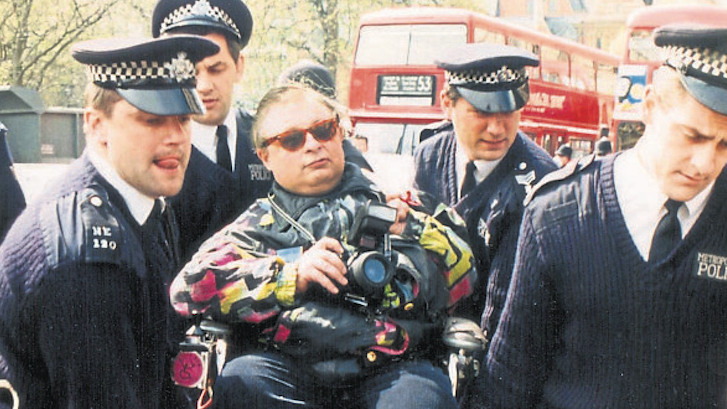
As a child he contracted polio and used a wheelchair for most of his life, but he attended countless demonstrations for a wide variety of causes and was arrested several times. He took hundreds of photos of these events.
When Keith contracted polio, he and his mother left their home in South Africa and returned to the UK. He attended Hephaistos School for boys with disabilities. At 16, he launched his own poetry magazine, the Informer.
In the early 1970s, Keith acquired a council flat in Euston, north London. Many disability rights activists passed through the flat, some of them working as his helpers, and he influenced all of them.
He was involved in the campaign for accessible transport (CAT) of late 80s and 90s, during which he was arrested with six others for blocking New Oxford Street. The case was thrown out of court as the courthouse did not then have ramp access for defendants using wheelchairs.
Despite a strong distrust of government, he became an adviser to several London boroughs, serving on the management committee of Camden’s Dial-a-Ride scheme during the 1980s, chairing it 1984-86, and to London Transport. In 1986 he was a consultant to the Greater London council (GLC) on its disability awareness handbook, and in 1994 he travelled to the USA to research public transport accessibility.
He continued protesting throughout the 1990s and 2000s with the Disabled People’s Direct Action Network (DAN), whose campaigning led to improvements to bus, tube and train access, as well as the introduction of the Disability Discrimination Act in 1995. He met or worked with many other activists of the period.
Keith’s collection is a major part of NDMAC and he stands as a good example of the strong individuals that came together to collectively agitate for Disabled people’s civil rights.
Activist
Depositor